

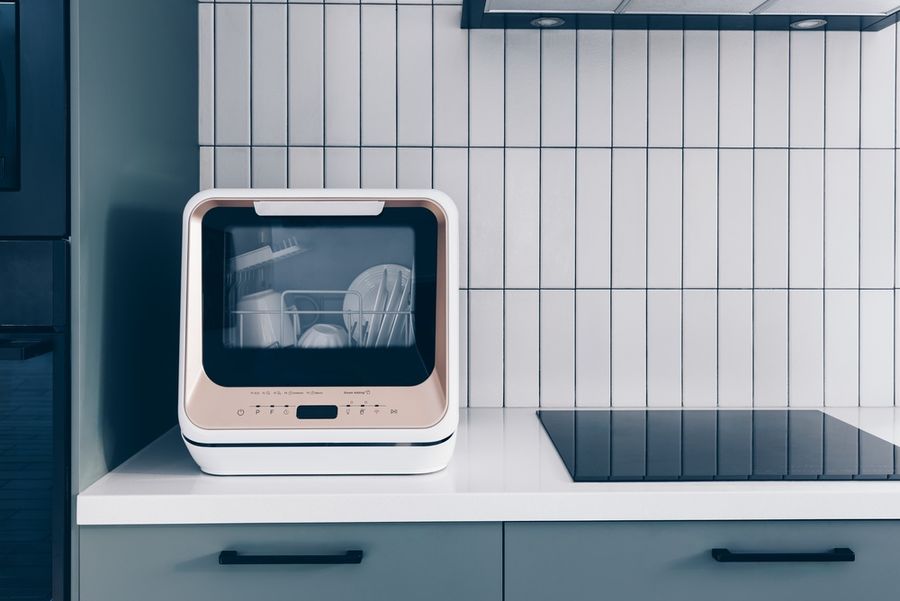
A countertop dishwasher can make daily cleanup easier for apartment renters who cannot install a full-size built-in unit. Before buying, however, check that the faucet accepts the required adapter, the counter provides enough depth and door clearance, and the drain hose can reach the sink safely. Faucet-connected models also occupy the tap during each cycle, so renters must weigh simpler filling against temporarily losing normal sink access.
A Four-Part Apartment Fit Check
Evaluate a countertop model through four connected criteria: lease compatibility, faucet connection, counter clearance, and daily water handling.
Lease rules determine whether the setup can remain temporary and reversible. Faucet design controls whether the included adapter will attach securely. Counter measurements determine whether the machine can sit and open safely, while the filling and draining routine reveals how much sink access the household must give up during use.
The Four Criteria That Matter Most
A compact exterior does not guarantee an easy apartment setup. The dishwasher, faucet, sink, counter, cabinets, and daily routine must work together.
1) Lease Rules and a Reversible Setup
A countertop dishwasher normally plugs into an outlet and either connects temporarily to a faucet or draws water from a built-in tank. That can avoid cutting cabinets or installing permanent plumbing, but renters should still check the lease and building rules before bringing in an appliance that uses a water connection. Restrictions may cover additional appliances, fixture changes, water-damage responsibility, or equipment left on shared utility surfaces.
A reversible setup should be removable without damaging the faucet, counter, wall, or plumbing. Save the original faucet aerator, washers, and packaging so the sink can be restored when moving. Avoid drilling holes, changing supply lines, or attaching permanent hardware without written approval.
Quick test: Confirm that every part of the proposed setup can be disconnected and the kitchen returned to its original condition with basic hand tools.
2) Faucet Aerator and Adapter Compatibility
Faucet-connected models usually require a fixed spout with a removable aerator and compatible threads. The existing aerator is removed, an adapter is installed, and the inlet assembly locks onto that fitting. One GE Appliances portable-dishwasher adapter fits standard spouts with internal or external threads and that the connector supplies hot water while draining used water into the sink.
Compatibility becomes less predictable with pull-down heads, integrated spray functions, unusual thread sizes, decorative aerators, or faucets whose aerators cannot be removed. A separate side sprayer can also create concerns because the line may remain under pressure throughout the cycle. Do not assume that a generic adapter will make every faucet suitable.
Quick test: Unscrew the aerator, photograph the exposed threads, and compare the faucet type with the exact adapter requirements in the dishwasher manual before ordering.
3) Counter Depth, Height, and Door Clearance
Measure more than the empty patch of counter. The dishwasher needs enough width and depth for its body, space behind it for hoses and the power cord, and room in front for the door to lower without striking the faucet, sink edge, cabinet handle, or items stored nearby. Upper cabinets may also limit height, especially when the machine has a top control panel or must be lifted slightly for drainage.
Current six-place-setting models can occupy much of a standard counter section. For example, one faucet-connected countertop model measures at 21.7 inches wide, 19.7 inches deep, and 17.2 inches high, with an inlet hose, drain hose, faucet adapter, and quick-connect fitting included. The figures illustrate why the full footprint matters more than the word “compact.”
Quick test: Mark the listed dimensions on the counter with removable tape, then open nearby doors and imagine the dishwasher door lowered for loading.
4) Filling, Draining, and Temporary Faucet Loss
A faucet-connected model simplifies filling because the sink supplies water directly. The trade-off is that the connector occupies the faucet while the dishwasher fills, washes, rinses, and drains. The sink basin must also remain clear enough for wastewater to drain without the hose becoming blocked, displaced, or submerged.
A built-in tank keeps the faucet available after filling, but the user must pour in the required water before each cycle and still route the drain hose into the sink or another approved container. That design may suit an incompatible faucet, although manual filling adds lifting and repeated trips with a pitcher.
Quick test: Picture the entire cycle at the busiest time of day and decide whether the household can leave the faucet and part of the sink unavailable until washing is complete.
The Shortcuts That Cause Apartment Setup Problems
The most common shortcut is buying by place-setting capacity without measuring the full operating space. A dishwasher may fit beneath a cabinet with the door closed yet become awkward to load because the open door reaches over the sink or blocks a drawer. Hoses bent sharply behind the unit can also turn a barely adequate counter into a poor installation area.
Another mistake is assuming that a removable aerator guarantees compatibility. Thread direction, diameter, faucet shape, spray features, and adapter clearance all matter. Removing the aerator before purchase is more useful than relying on a product photo that shows only a generic faucet.
Renters may also focus on the lack of permanent plumbing and overlook the daily workflow. A temporary connection still changes how the sink can be used during a cycle. A household that cooks while the dishwasher runs may find that limitation more disruptive than someone who starts the machine after the kitchen has been cleaned.
Three Apartment Situations With Different Priorities
Different kitchens move different criteria to the front of the decision.
For a renter with a compatible fixed-spout faucet:
Choose a faucet-connected model when the aerator accepts the supplied adapter, the lease permits a temporary appliance, and the household can give up faucet access during the cycle. Direct filling removes the need to pour several pitchers into a tank. The accepted trade-off is keeping the connector and drain arrangement in place until the cycle ends.
For a renter with a pull-down or incompatible faucet:
Give reversible setup and water handling more weight by considering a built-in-tank model. Manual filling avoids forcing an adapter onto an unsuitable faucet and leaves the fixture unchanged. The trade-off is a smaller interior in many tank-style designs, more hands-on filling, and the continued need to manage a drain hose.
For a renter with very little counter space:
Prioritize the complete operating footprint rather than capacity or cycle count. A smaller model may preserve food-preparation space, while a movable cart could keep the machine off the main counter if the hoses and outlet remain safely within reach. The trade-off is more frequent loads or the need to move the appliance before and after use.
Purchase Cost, Accessories, and Ongoing Constraints
The dishwasher is not always the full setup. A renter may also need a compatible faucet adapter, replacement washers, a stable cart or stand, a longer approved drain arrangement, or a drying rack for items that do not fit. Buyers should check what comes in the box before assuming that “quick connect” means every required part is included for their sink.
Faucet-connected and tank models also create different ownership burdens. An adapter and hose assembly must be attached, checked for leaks, disconnected, and stored. A tank model requires manual filling and access to the reservoir. Both designs need filter cleaning, spray-arm checks, detergent storage, and a drainage routine that does not leave water on the counter or floor.
Return terms matter because faucet and counter fit can be difficult to judge from specifications alone. Keep all packing materials until the connection, door clearance, hose reach, and normal kitchen workflow have been tested without making permanent changes.
Choose Around the Sink Before Comparing Wash Cycles
The first decision is not which model offers the most programs. It is whether the apartment’s lease, faucet, counter, and sink routine can support the machine without damage or constant inconvenience. Measure the full operating area and identify the faucet’s aerator type before choosing between direct connection and manual filling.